Home > Blog > Paid Advertising
Google Ads vs. TripAdvisor Ads for Riads & Hotels in Morocco: Which Channel Generates Real Revenue and in What Sequence to Deploy?
By Urunk Paid Media Team | October 10, 2026 | 10 min read
Google Ads or TripAdvisor Ads for your hotel or riad in Morocco? Learn which channel to choose based on traveler intent, decision matrix, and action plan.
For owners and managers of riads, boutique guesthouses, and small independent hotels operating with focused advertising budgets.
Hotel owners frequently ask: should we invest in Google Ads or TripAdvisor Ads? In practice, the answer depends far less on the platforms themselves than on where your prospective guest stands within their booking journey. This guide delivers a structured decision framework tailored to the Moroccan hospitality market, key financial metrics to track, and common pitfalls that burn ad spend without driving direct revenue.
1. Two Platforms, Two Distinct Buying Moments
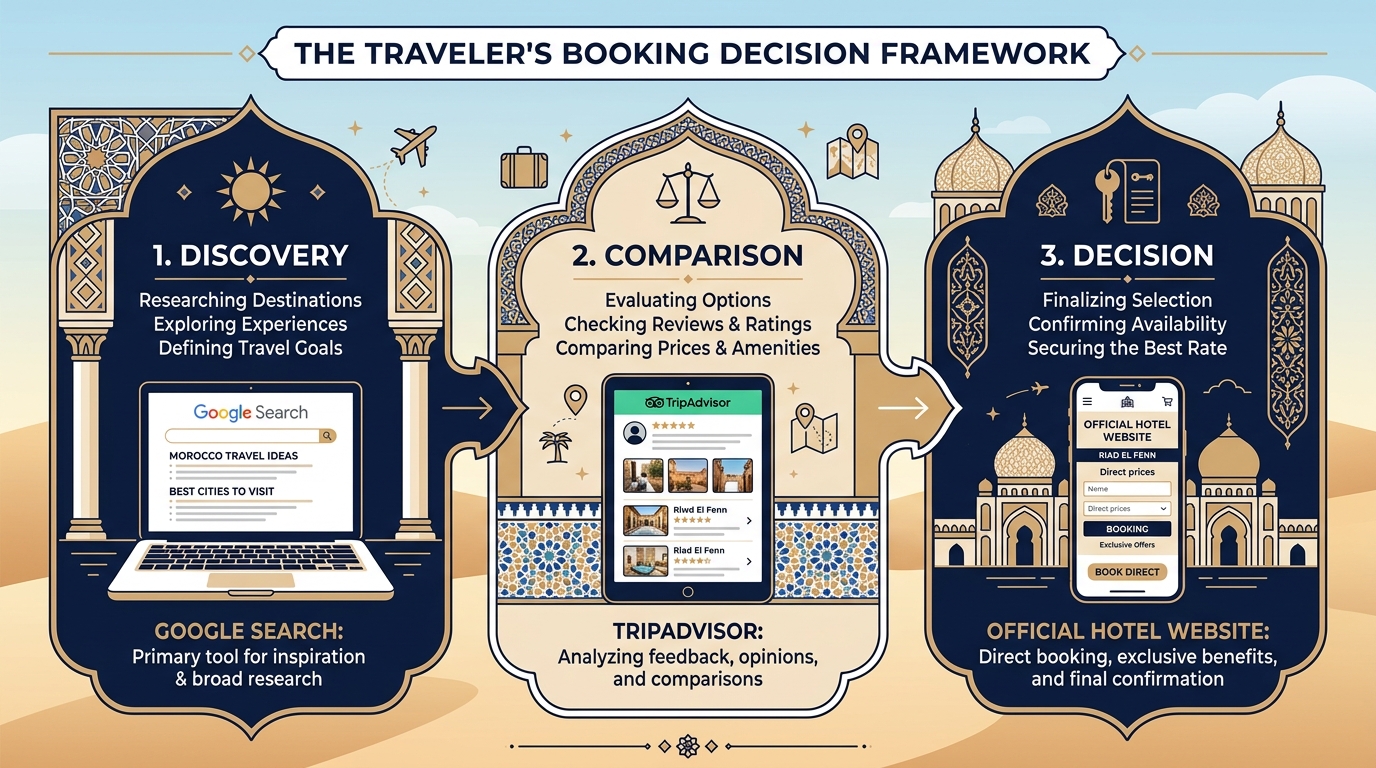
A traveler searching for accommodation in Marrakech or Fes does not follow a linear path. They move through three primary stages: discovery ("riad Marrakech"), active comparison (guest reviews, photo galleries, amenity filters), and final decision (booking direct vs. booking on an OTA).
- Google Ads intercepts the decision stage, when a traveler submits high-intent search queries ("book riad medina Marrakech with pool", "authentic boutique hotel Fes", or your exact property name).
- TripAdvisor operates predominantly during the comparison phase, while travelers compare reviews, browse unfiltered guest candid photos, and benchmark properties within the same destination category.
This fundamental difference explains why these two channels are complementary rather than interchangeable. Misallocating budget means paying for clicks before the guest is ready to book, or allowing an OTA to capture your branded traffic at the final decision point.
2. Strengths and Vulnerabilities of Each Channel
✓ Google Ads: Core Strengths
- Brand Name Defense: Prevents Booking.com and Expedia from bidding on your property name and hijacking direct guests.
- Granular Geo-Targeting: Restrict ad delivery strictly to high-value source markets (France, UK, US, Spain, Germany, Switzerland) while excluding non-converting regions.
- Surgical Performance Measurement: Search term reports reveal exact high-converting queries and allow instant negative keyword pruning.
✗ Google Ads: Core Limitations
- Cost-per-click on broad generic keywords ("Marrakech hotel") can escalate rapidly against billion-dollar OTA budgets.
- Without a sub-2.5s mobile website and clean booking engine, paid clicks simply bounce without converting.
✓ TripAdvisor Ads: Core Strengths
- Comparison Stage Dominance: Pin your property to the top of city ranking results while travelers actively evaluate accommodations.
- Social Proof Leverage: Strong ratings (4.5/5+ or Travellers' Choice) amplify trust that competitors cannot simply buy.
✗ TripAdvisor Ads: Core Limitations
- You operate within a walled garden, directly competing alongside other properties on a third-party platform.
- Properties with few reviews or ratings below 4.3/5 rarely achieve acceptable direct booking ROI.
- Ad formats and CPC models update frequently; verify terms directly with TripAdvisor representatives.
Neglecting brand name bidding on Google Search. When an OTA bids on your name, they capture travelers who intended to book directly with you. Bidding on your own brand typically costs pennies per click and secures the highest direct margin possible.
3. The Strategic Decision Matrix
We benchmark each platform across six rigorous operational dimensions:
| Criteria | Google Ads (Brand + Destination) | TripAdvisor Sponsored Ads |
|---|---|---|
| Guest Journey Stage | Final Decision & Direct Intent | Active Comparison & Brand Consideration |
| Core Prerequisite | Ultra-fast mobile site & frictionless booking flow | Strong review volume & high rating (> 4.3/5) |
| Creative & Funnel Control | High (custom ad headlines & tailored landing pages) | Limited (standard platform listing template) |
| Measurement Precision | Exact (queries, CTR, GA4 enhanced ecommerce revenue) | Less granular, focused primarily on outbound clicks |
| Setup & Optimization Effort | Medium (campaign structure, match types, negatives) | Low to Medium |
| Primary Financial Risk | Wasting spend on broad generic keywords | Advertising a listing lacking fresh recent reviews |
Our Three Diagnostic Questions:
- Can a traveler book directly on mobile in 3 taps? If not, do not run paid ads. Fix your mobile funnel first.
- Do you possess consistent, fresh reviews? If not, prioritize guest checkout review generation over TripAdvisor advertising.
- Is your brand name defended on Google? If not, this is your number one priority, with minimal cost per acquisition.
Always begin with a Google Ads campaign strictly limited to your property name and immediate location ("riad [name] Marrakech"). Cost per click is drastically lower than generic destination terms, delivering immediate data on direct conversion rates before scaling ad spend.
4. Chronological Implementation Plan
Rather than choosing between platforms, execute this tested chronological rollout:
Phase 1: Funnel Optimization (Weeks 1 to 4)
Audit mobile load speed on live Moroccan 4G networks, clock booking completion times, and verify persistent conversion buttons across every suite page.
Phase 2: Brand Protection on Google (Weeks 3 to 6)
Launch branded Google Search campaigns on modest daily budgets. Monitor search term queries and direct booking confirmations.
Phase 3: High-Intent Destination Expansion (Weeks 6 to 10)
Add hyper-specific destination terms ("luxury riad heated pool medina") with strict exact/phrase match and negative keyword safeguards. Compare cost per booking against OTA commission savings.
Phase 4: Evaluate TripAdvisor Ads (Month 3+, Review Volume Permitting)
Activate sponsored placements only once ratings consistently exceed 4.3/5. Test over a defined 60-day window with clear direct booking targets.
5. Calculating True Advertising Return
Platform-reported ROAS can be misleading. Measure actual cost per direct booking:
Cost Per Direct Booking = Monthly Ad Spend ÷ Total Attributable Direct Bookings
Always benchmark this figure against your average saved OTA commission.
Concrete Example: If an average 2-night stay of 1,200 MAD/night (total 2,400 MAD) incurs an 18% OTA commission (roughly 432 MAD), an ad campaign acquiring direct stays at 150 MAD to 200 MAD per booking delivers immediate profit expansion.
Frequently Asked Questions
Should we add "Booking" and "Airbnb" as negative keywords in Google Ads?
Yes, in almost all scenarios. Searchers including third-party brand names are explicitly looking to navigate to that specific platform. Review your search term reports weekly to add these negative keywords, including common misspellings.
How do we know if our TripAdvisor reviews justify paid placement?
Benchmark your property against local competitors in your category. If your rating or recent review velocity is lower than top-ranked peers in your medina or neighborhood, invest in checkout review generation before spending on sponsored listings.
How should we divide a monthly ad budget under €1,000 / 10,000 MAD?
Allocate roughly 70% to Google Ads brand protection and high-intent local search, which convert reliably at lower acquisition costs. Reserve 30% for Meta retargeting or TripAdvisor testing once tracking and attribution are solid.
Key Metrics & Benchmarks
A performance comparison between industry average hospitality channels dependent on third-party OTAs versus optimized Urunk client channels: