OTA Commissions in Morocco: How Much Does a Booking.com Reservation Really Cost, and Which Lever Should You Activate First?
By Urunk Hospitality Strategy Team | October 15, 2026 | 10 min read
Calculate the true cost of a Booking.com reservation for your riad in Morocco. Concrete math, decision matrix, and a 90-day action plan to reclaim direct margins.
For owners and managers of riads, boutique guesthouses, and independent hotels in Morocco.
In most riads we advise across Marrakech, Fes, and Essaouira, owners know their nominal Booking.com commission rate (15% to 18%+). Yet very few calculate what this represents in Moroccan Dirhams over a full year: often exceeding 200,000 MAD lost on an 8-room property. This guide starts with this exact calculation, then provides a pragmatic method to prioritize direct booking levers without lowering room rates or cutting ties with OTAs that provide valuable top-of-funnel reach.
1. Calculating the True Cost of an OTA Room Night
The visible cost is the contract commission, typically 15% to 18% for standard accounts, and higher with visibility boosters. The actual economic cost is significantly higher, because it encompasses hidden overhead and rate erosion that rarely appear on monthly statements.
| Cost Component | Typical Impact | Strategic Detail |
|---|---|---|
| OTA Commission | 15% to 18% | Calculated on the gross guest payment (including local taxes and breakfast) |
| Visibility Add-ons | +2% to +5% extra | Genius programs, Preferred Partner badges, and sponsored placement campaigns |
| Imposed Rate Discounts | Variable (10% to 20%) | Member-only pricing, mobile app discounts, and early-bird promotional deductions |
| Management Overhead | Labor intensive | Manual extranet sync, dispute resolution, guest messaging within proprietary apps |
| Channel Dependency | High risk | You do not own the guest's email, phone number, or relationship for repeat stays |
Illustrative Example (Replace with your actual figures):
Consider a typical riad with 8 rooms, an average daily rate (ADR) of 1,200 MAD, and a 60% average occupancy rate. This yields 144 room nights and 172,800 MAD in monthly gross revenue.
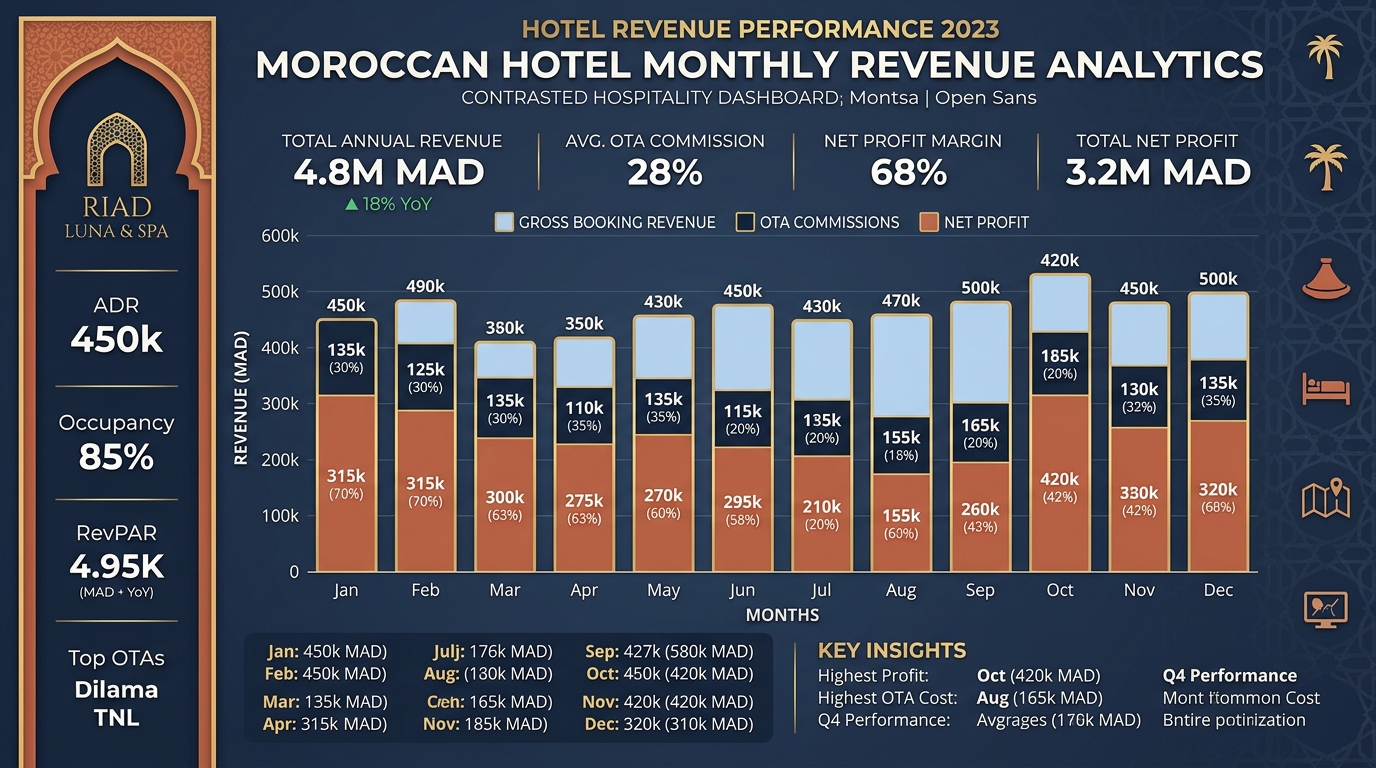
If 60% of this revenue originates from an OTA at an 18% commission rate, you are remitting approximately 18,660 MAD per month, which totals nearly 224,000 MAD every single year directly to the platform.
Calculate your true blended commission rate over the trailing 12 months by dividing total OTA commissions by gross accommodation revenue. This number is almost always higher than your headline contractual rate and serves as your baseline benchmark.
2. The Decision Matrix: Which Lever, in What Sequence?
Not all direct booking tactics deliver the same efficiency. We evaluate each channel across four rigorous criteria: cost per direct acquisition, time to impact, ownership control, and implementation effort.
| Strategic Lever | Est. Cost Per Direct Booking | Time to Impact | Control | Initial Effort |
|---|---|---|---|---|
| Direct Booking Engine on Website | Very low once deployed | 4 to 8 weeks | High (100%) | Medium |
| Exclusive Non-Rate Value Perks | Low (operational marginal cost) | Immediate | High | Low |
| Google Ads Brand & Geo-Search | 5% to 9% of booking value | 1 to 2 weeks | Medium | Medium |
| Meta Retargeting (Instagram & FB) | 6% to 11% of booking value | 3 to 6 weeks | Medium | Medium |
| Post-Stay Email & WhatsApp Flows | Negligible | 2 to 3 months | High | Low to Medium |
Our Three Diagnostic Questions:
- Are travelers already searching for your property by name? If yes, your immediate priority is conversion optimization and brand defense, not awareness.
- Can a traveler complete a booking on mobile within 3 taps? If not, paid traffic will merely leak to Booking.com after clicking your ad.
- Do you capture and own guest contact details upon checkout? If not, every stay represents a lost opportunity for recurring direct revenue.
Launching paid Google Ads before resolving your mobile checkout flow. You pay for the initial click, the user encounters a clunky interface or cannot see real-time rates, and returns to Booking.com to book. You have effectively paid Google to subsidize an OTA commission.
3. The Direct Booking Engine: The Foundation of Independence
The single most common operational error is treating your hotel website as an aesthetic brochure. It must operate as an agile sales engine synchronized with your central Property Management System (PMS).
| Traditional Outdated Practice | High-Performance Standard |
|---|---|
| Generic "Contact Us" or slow email inquiry form | Real-time booking engine connected to PMS (Cloudbeds, SiteMinder, Mews) |
| Opaque pricing without comparative value clarity | Transparent direct rate with exclusive direct-booking benefits clearly highlighted |
| Single language website | Native French, English, Spanish, and Arabic matching your primary traveler profiles |
| Heavy unoptimized photo galleries (> 6s load) | Modern WebP/AVIF compression with mobile sub-2.0s Core Web Vitals performance |
| Booking strictly via manual WhatsApp messages | Instant PMS checkout with pre-filled WhatsApp concierge as an instant support channel |
Morocco-Specific Constraints to Build Into Your Checkout:
- Payment Processing: Support international credit cards (CMI, Stripe, 3D-Secure) alongside localized options. While pay-at-property is customary, requiring a small deposit (20%–30%) drastically curbs no-shows.
- WhatsApp Integration: In Morocco, WhatsApp is the dominant communication channel. A prominent floating WhatsApp CTA that opens a pre-filled message with chosen check-in dates removes friction instantly.
- Mobile Network Reality: Test your website over live Moroccan 4G mobile networks, not just high-speed office fiber optic connections.
- Regional Seasonality: Marrakech, Fes, Essaouira, and Chefchaouen exhibit starkly different seasonal demand peaks. Your rate strategy and ad pacing must adapt dynamically.
Audit your mobile checkout flow in private browsing mode with a stopwatch. If reaching the confirmation screen takes over two minutes or requires more than four clicks, you are needlessly surrendering guests to Booking.com.
4. Direct Perks: Creating Compelling Value Without Violating Rate Parity
Strict rate parity clauses forbid publicly listing cheaper headline room rates on your site than on major OTAs. However, parity rules do not restrict adding exclusive tangible value. Consider high-perceived-value, low-cost inclusions:
- Complimentary Airport Transfer: Free one-way or round-trip airport transport on minimum stays (e.g., 3+ nights) utilizing trusted local driver partnerships.
- Traditional Welcome Experience: High-grade Moroccan mint tea with artisan gazelle horns, or a complimentary 20-minute welcome hammam ritual for longer visits.
- Priority Room Upgrades: Guaranteed top-priority room selection upon arrival subject to availability.
- Flexible Cancellation Window: Slightly more lenient cancellation terms for direct guests compared to OTA restrictions.
5. Practical 90-Day Direct Booking Roadmap
Weeks 1–2: Diagnostic & Auditing
Calculate your trailing 12-month commission total, benchmark your mobile checkout speed, and review current PMS guest database exports for clean contact lists.
Weeks 3–6: Conversion Infrastructure
Embed an instant PMS booking widget, deploy sticky mobile conversion bars, set up the pre-filled WhatsApp concierge, and configure Google Analytics 4 enhanced e-commerce tracking.
Weeks 7–12: Acquisition & Retention
Activate brand-protection Google Ads campaigns targeting top source markets (France, UK, US, Spain), implement front-desk email capture routines, and launch automated post-stay re-engagement emails.
Frequently Asked Questions
Can we offer lower rates directly by bundling services without breaking parity?
This depends on specific contractual language. Some agreements prohibit lower public rates even when bundled. However, private member-only rates (revealed via an email signup or WhatsApp promo code) are fully compliant across almost all standard OTA contracts.
How should we attribute direct bookings when a traveler visits multiple times across devices?
Rely on data-driven multi-touch attribution in GA4 rather than single last-click models. More importantly, observe the holistic trend in your monthly OTA commission invoices: a sustained reduction in fees alongside stable occupancy is the ultimate metric of success.
When is the right moment to downgrade or leave an exclusive OTA program?
When your direct booking channels reliably generate at least 40%–50% of your total room nights. Never sever relationships abruptly; systematically negotiate commissions down as your brand strength grows.
Key Metrics & Benchmarks
A performance comparison between industry average hospitality channels dependent on third-party OTAs versus optimized Urunk client channels: