Home > Blog > Pricing & Strategy
How Much Does a Direct-Booking Website for a Moroccan Riad or Boutique Hotel Cost in 2026, and How Quickly Does It Pay for Itself?
By Urunk Pricing & Strategy Desk | September 22, 2026 | 10 min read
How much does a direct-booking hotel website cost in Morocco in 2026? Itemized quotes, hidden costs, payback timeline matrix, and realistic ROI formulas.
For owners and managers of riads, boutique guest houses, and independent hotels considering a website overhaul.
The quotes we review vary dramatically—often by a factor of three—for projects that appear identical on paper. The discrepancy rarely stems from the baseline template; it originates from added modules, required language locales, and overlooked recurring operational costs. This guide details the essential quote components, hidden fees, and a realistic calculation framework to evaluate your payback period without unrealistically assuming that every direct booking seamlessly replaces an OTA reservation.
1. What a Professional Quote Actually Covers
A high-converting direct-booking website consists of five foundational pillars. Any agency quote covering only two or three must be clarified before signing:
| Component | Indicative Range (EUR) | What It Must Include | Crucial Question to Ask |
|---|---|---|---|
| UX/UI Design & Development | €800 to €2,000 | Custom mobile layouts, Core Web Vitals optimization, room pages | How many custom room template variations are included? |
| PMS & Booking Engine Integration | €200 to €500 | Live API/iFrame integration, real-time rate & calendar synchronization | Which PMS platforms are supported and how is payment handled? |
| Multilingual Architecture & Local SEO | €200 to €600 | Native sub-URLs (/en, /fr), hreflang tags, metadata localization | Are language URLs independently crawlable and indexed by Google? |
| Content Production & Photography | Variable | Professional interior photography, copywriting, image compression | Who writes the room descriptions and edits high-res WebP assets? |
| Deployment, Analytics & E-commerce GA4 | Variable | GA4 enhanced e-commerce tracking, conversion events, CAPI setup | Is end-to-end booking conversion tracking in GA4 included? |
Always request that prospective web agencies itemize these five components separately. A lump-sum "€1,200 all-inclusive" quote is impossible to compare objectively, and omitted modules almost always surface as unexpected extra costs after contract signing.
2. The Recurring Costs Proposals Often Ignore
The initial build cost is merely the first milestone. Three recurring cost categories occur every year:
- High-Speed Hosting & Domain Management: Typically modest (€80 to €200/year), but essential for sub-second mobile page loads across European and North American markets.
- Software Licenses & Plugins: Translation modules (WPML), security firewalls, and backup suites require active annual licenses. Ensure licenses are issued in your establishment's name rather than locked inside the agency's account.
- Ongoing Technical Maintenance: Core updates, security patches, and PMS widget synchronization checks prevent revenue leaks. An unmaintained hospitality website degrades within months.
Additionally, factor in direct booking transaction fees (payment gateways like CMI or Stripe at 1.5% to 3%, plus PMS subscription fees). While a direct booking is not 100% free of transaction costs, paying 2.5% in payment processing is exponentially more profitable than surrendering 18% to 22% to an OTA.
Comparing the upfront setup fee of two proposals without factoring in their 3-year Total Cost of Ownership (TCO). A cheaper baseline website with exorbitant hourly maintenance retainers and proprietary hosting lock-ins frequently costs double over a 36-month horizon.
3. Calculating Financial Payback Without Wishful Thinking
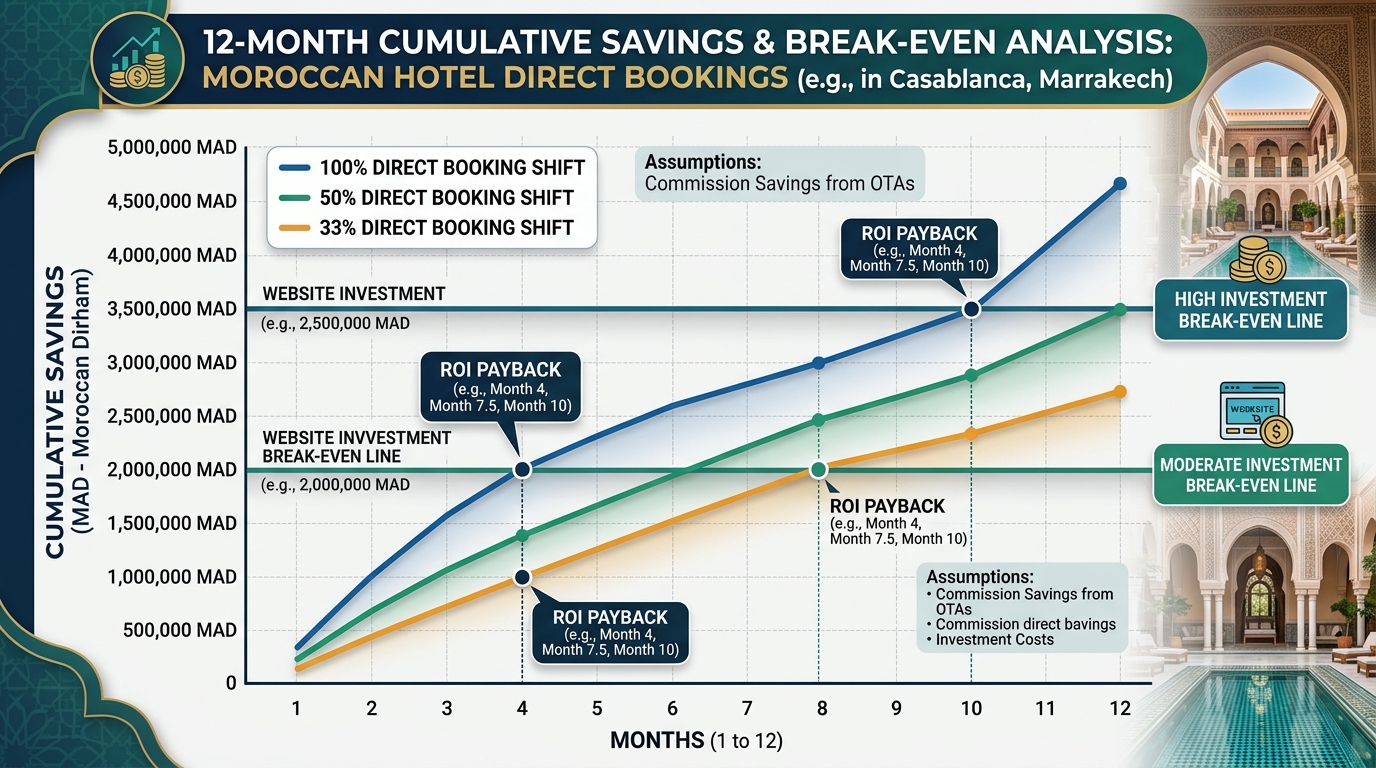
Common payback calculations frequently fail by assuming that 100% of OTA bookings instantly transition to direct bookings. To calculate a realistic payback timeline, use this grounded equation:
Monthly Savings = Monthly OTA Booking Volume × Shifted Direct Share × OTA Commission Rate
Example: €6,000 monthly OTA revenue × 33% shifted to direct × 18% commission = €356 net monthly savings.
| Scenario | Total Implementation Cost | Shifted Direct Share | Net Monthly Savings | Payback Period |
|---|---|---|---|---|
| Optimistic (High brand loyalty) | €1,200 | 100% | €1,080 | ≈ 1.1 months |
| Realistic Baseline (Balanced mix) | €2,000 | 33% | €360 | ≈ 5.6 months |
| Conservative (High custom development) | €3,100 | 33% | €360 | ≈ 8.6 months |
4. Key Variables Influencing Website Costs
- Language Requirements: Every additional language multiplies copywriting, SEO metadata, and quality assurance requirements. Prioritize your top 2-3 feeder markets based on real PMS guest records before translating blindly.
- Engine Connectivity: Integrating established PMS widgets (Cloudbeds, SiteMinder, Mews) is clean and cost-effective compared to custom proprietary API builds.
- Visual Asset Quality: High-resolution, professional architectural photography and video clips represent an upfront cost that pays exponential dividends in direct conversion rates.
5. Handling Dirham (MAD) and Euro Quotes
Quotes in Morocco are frequently presented in Moroccan Dirhams (MAD), while comparison benchmarks and international software subscriptions operate in Euros (EUR). Currency fluctuations can distort multi-month cost evaluations. Maintain a fixed reference exchange rate in your internal comparison spreadsheet and explicitly confirm whether local VAT (TVA) is included.
6. A 4-Week Decision Roadmap
Week 1: Scope & Specification Document
Catalog room inventory, target feeder market languages, existing PMS engine, and calculate your real OTA commission spend over the preceding 12 months.
Week 2: Formal Proposals
Submit the identical specifications to at least three specialized hospitality agencies. Require separate line items for build, integrations, and annual maintenance.
Week 3: Financial & Technical Analysis
Populate the 3-tier payback scenario matrix using the quoted numbers to calculate realistic break-even dates.
Week 4: Selection & Performance KPIs
Select your development partner, establish contractually binding delivery deadlines, and define the 6-month target direct booking percentage.
Practical FAQ
Can an independent riad achieve full payback in under two months?
Yes, if a meaningful portion of your OTA guests represents repeat visitors or referrals that can be easily funneled direct, and your site is optimized for frictionless 3-tap mobile bookings. For properties starting from scratch, 5 to 8 months is the realistic industry benchmark.
Must payment gateway fees be factored into payback calculations?
Absolutely. Direct reservations incur transaction fees (CMI/Stripe processing at 1.5% to 3%). However, saving 15% to 18% in OTA commissions while paying 2.5% in payment processing represents a massive net margin gain.
Is a budget "€1,200 website" sufficient for an independent Moroccan property?
Yes, provided the agency delivers clean mobile responsiveness, live calendar synchronization, and localized multi-language setup (such as Urunk's Core Hospitality Package). Always scrutinize the contract to ensure essential modules aren't excluded.
Key Metrics & Benchmarks
A performance comparison between industry average hospitality channels dependent on third-party OTAs versus optimized Urunk client channels: