Home > Blog > Website Optimization
5 Critical Signs Your Moroccan Hotel Website Is Sending Guests to Booking.com, and How to Test It in One Hour
By Urunk UX Audit Group | September 15, 2026 | 9 min read
Is your hotel website leaking bookings to Booking.com? Discover the 5 warning signs, the private mobile test methodology, and the step-by-step fix roadmap.
For owners and managers of riads, guest houses, and independent hotels experiencing heavy OTA dependency.
A website that hemorrhages bookings rarely throws an obvious error. It displays your photos, loads a contact form, and allows the prospective guest to bounce straight back to Booking.com without leaving a trace. This guide provides five field tests you can execute on your smartphone in under one hour to diagnose and eliminate critical UX friction points.
Methodology: The Private Mobile Browser Test
Before testing, replicate authentic guest conditions:
- A smartphone operating in an incognito / private browsing window.
- A genuine mobile cellular data connection (4G or 5G), avoiding office fiber Wi-Fi.
- A stopwatch.
- A Google search query for your exact riad name, mimicking an international traveler.
Sign 1: Your Website Takes Too Long to Render on Mobile
Mobile load speed directly governs booking conversion. While PageSpeed scores provide technical benchmarks (LCP < 2.5 seconds), real human patience on mobile is under three seconds before bouncing back to Google or Booking.com.
Test: Access your site from a Google search on mobile cellular data and time the seconds before your hero patio image and primary booking CTA render fully. Repeat three times.
Unoptimized photo galleries are the primary cause of mobile sluggishness on riad websites. An 8MB raw courtyard image loaded on mobile will paralyze page rendering. Compress and convert key visual assets to next-generation WebP or AVIF formats.
Sign 2: Visitors Can Only Inquire, Not Book Instantly
A static "Send Us an Inquiry" form creates immediate friction. The traveler wants instant room and date confirmation. By the time an email response arrives 12 hours later, the guest has already finalized a confirmed reservation on an OTA.
Test: From your homepage, attempt to book a specific date two months out. Does your site show live rates and availability with immediate checkout, or merely submit a lead form?
Deploying an unsynchronized booking engine that displays phantom availability. Discovering that a selected suite is unavailable after entering credit card information permanently destroys guest trust.
Sign 3: Website Languages Don't Match Your Actual Feeder Markets
If 65% of your staying guests arrive from the UK, US, and Germany, but your official site is exclusively in French, a substantial percentage of booking intent naturally defaults to multilingual OTAs.
Test: Review your PMS guest records from the past 12 months. Compare primary nationalities against the languages offered on your website. Any mismatch identifies an immediate translation priority.
Sign 4: No Direct-Booking Perks Are Prominently Highlighted
When a traveler compares your official website rate with Booking.com, price parity rules may prevent public rate undercutting. However, non-rate direct incentives—complimentary arrival mint tea and pastries, free airport transfers on 3+ night stays, flexible cancellation—must be showcased prominently.
Test: Land on your mobile homepage. How many seconds does it take to spot a compelling perk exclusive to direct bookings? If it requires scrolling or searching, it is invisible to guests.
Sign 5: The Reservation Button Is Buried or Hidden on Scroll
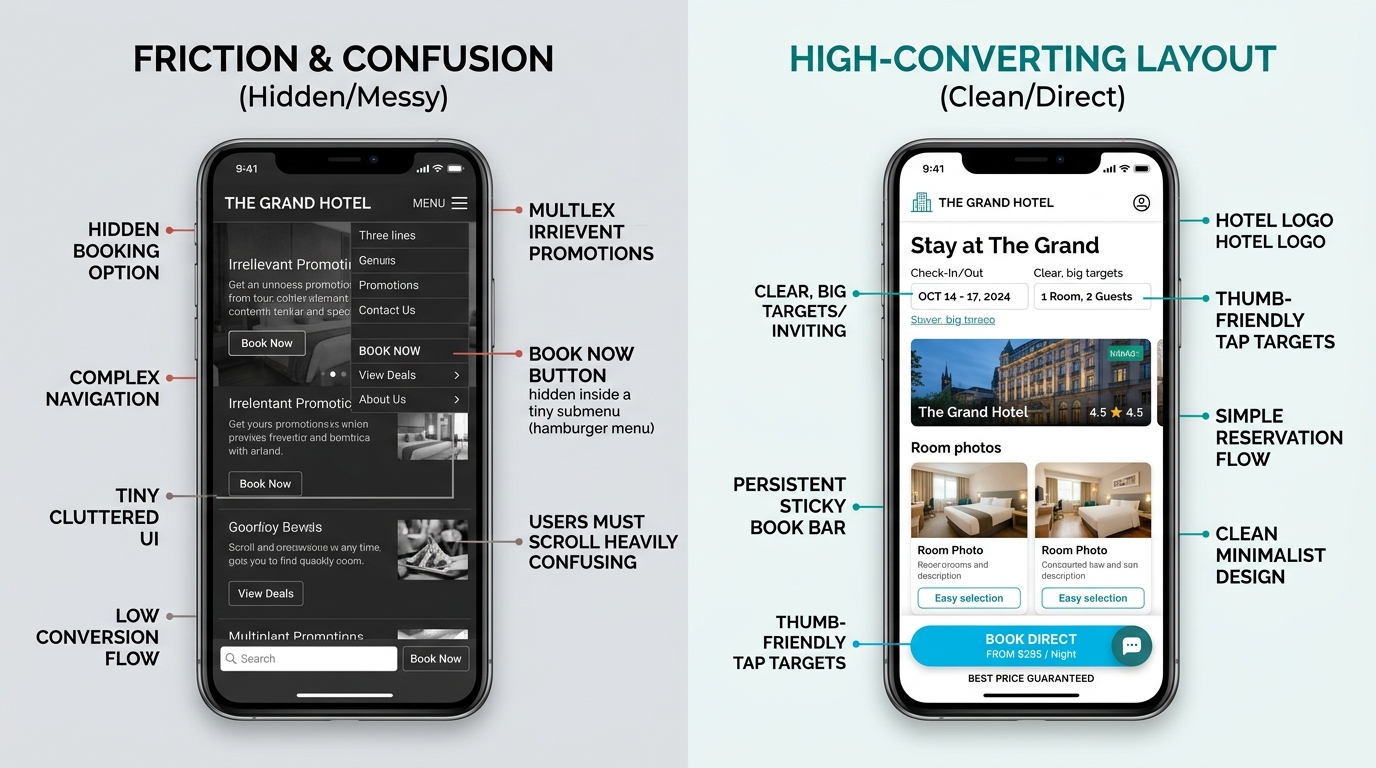
Forcing visitors to open a collapsed hamburger navigation menu just to find the booking link creates massive drop-off. A high-converting mobile layout must feature a persistent, sticky "Book Now" bar anchored to the bottom of the screen.
Test: Scroll down your mobile suite showcase. Does a clear, high-contrast booking button remain instantly tappable with one thumb at all times?
Immediate Corrective Sequence
If your audit reveals multiple red flags, address them in this strict order: first, optimize mobile loading speed and install a sticky mobile booking bar (immediate conversion lift); second, integrate a synchronized live booking engine; third, showcase direct booking perks and translate core pages.
Practical FAQ
Does an exceptional PageSpeed score guarantee high direct conversions?
No. Speed removes technical barriers, but compelling visual storytelling, clear direct perks, and a frictionless booking engine are what finalize the reservation.
Our booking engine is slow; should we replace it immediately?
First optimize its script loading (defer third-party scripts, lazy-load heavy assets). If technical optimization fails to bring booking load times under 2.5 seconds, migration to a modern cloud-native PMS engine is warranted.
How fast do UX corrections impact direct booking metrics?
Technical and layout enhancements (sticky mobile bar, speed boost) frequently demonstrate measurable conversion improvements within 3 to 6 weeks when evaluated across comparable booking windows.
Key Metrics & Benchmarks
A performance comparison between industry average hospitality channels dependent on third-party OTAs versus optimized Urunk client channels: